
Risk management
Risk management
AuditIQ GRC is IT risk management software with a live risk register, Risk Quantification (CRQ), Risk Genome and Risk Treatments. Identify, score, treat and track each risk, linked to the controls and frameworks it affects.
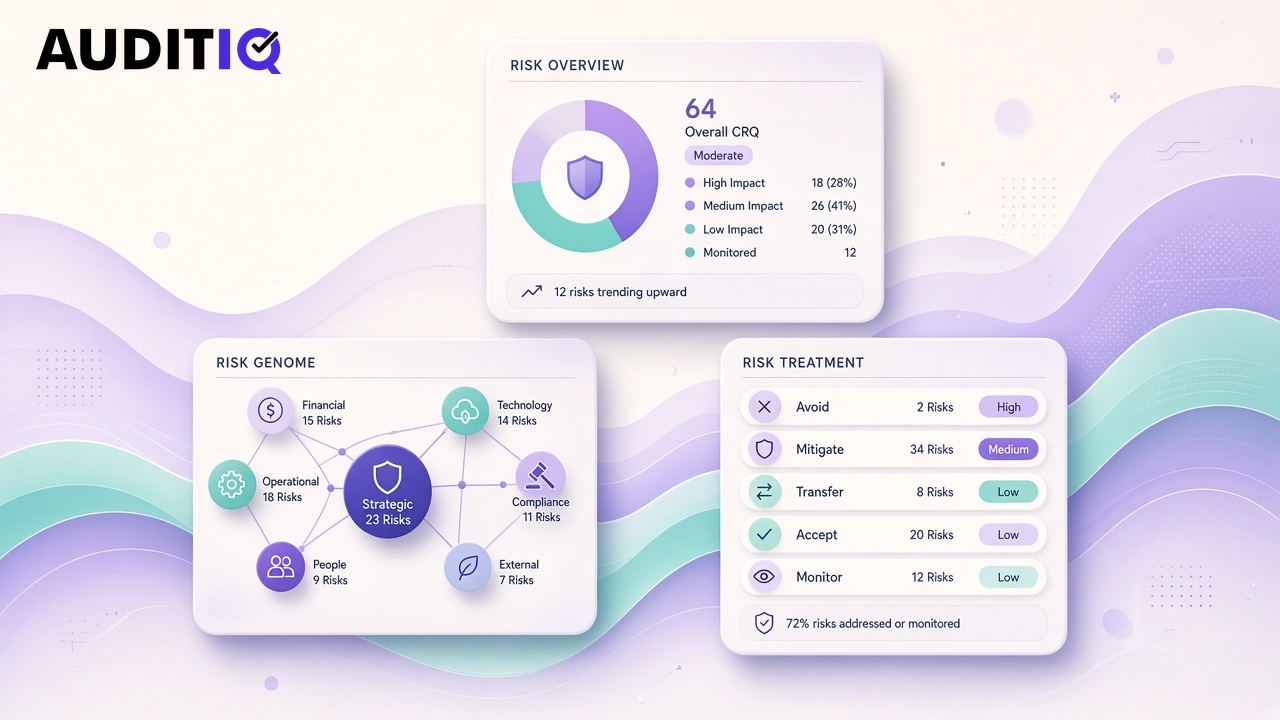
What does risk management do?
Live register
Risks stay tied to control and evidence status, not a quarterly spreadsheet refresh.
Configurable scoring
Use your likelihood and impact matrix, including INR impact bands for management review.
Risk Treatments
Mitigate, transfer, avoid or accept with owners, tasks and target residual scores.
Risk Quantification (CRQ)
Optional financial loss estimates so leadership can prioritise by rupees, not only colour.
Risk Genome
Map each risk to assets, controls, frameworks and related scenarios in one view.
Heat maps & acceptance
Board views plus who accepted residual risk, why, and when it must be reviewed again.
Risk Quantification (CRQ)
Cyber and operational risk in language the board already uses: expected loss, scenarios and priorities in INR.
Scenario-based loss
Attach financial impact bands or estimates to likelihood so high risks are not just “red”.
Prioritise spend
Compare treatment cost against residual exposure when you argue for budget.
Audit-ready trail
Keep the assumptions behind a CRQ figure with the risk record auditors will ask for.
CRQ sits on the same register as qualitative scoring, use either or both per risk.
Risk Genome
See the full picture around a risk: what it touches, what treats it, and which frameworks care.
Risk Genome links each risk to related assets, controls, policies, vendors and framework clauses. When a control fails or a vendor tier rises, you see which risks and obligations move with it, instead of hunting across sheets.
- Control and evidence links that drive live scores
- Framework tags for ISO 27001, DPDP, SOC 2 and more
- Related scenarios so duplicate risks are easier to merge
Why it matters
ISO 27001 clause 6.1 and DPDP security duties expect risk-based decisions you can explain. Risk Genome is the map that makes those explanations short and evidence-backed.
Risk Treatments
Every risk needs a decision: mitigate, transfer, avoid or accept, with work that actually closes.
Choose treatment
Record the strategy and residual target score on the risk.
Assign work
Link controls and tasks with owners and due dates.
Track progress
Scores update as linked controls pass or fail; history stays on the record.
Accept or escalate
Formal acceptance with approver and expiry when residual risk remains.
How risk management works
Identify
Start from a library of common IT, privacy and AI risks, or add your own.
Score
Rate likelihood and impact. Optionally quantify expected loss with CRQ.
Treat
Use Risk Treatments to link controls, owners and target residual scores.
Track
Scores update as controls pass or fail. Risk Genome keeps relationships visible.
What makes a good risk register?
One that is current. In AuditIQ GRC, each risk is tied to real control status, so when a control fails the risk goes up automatically. That is what ISO 27001 clause 6.1 and DPDP security safeguards expect: risk-based decisions you can show an auditor.
Who needs it in India
Any organisation building an ISMS, responding to DPDP security duties, or answering enterprise questionnaires about risk treatment. NBFCs and insurers often pair this module with on-prem deployment. Startups use it lightly at first, then deepen CRQ before board reviews.
Connected modules
- CRQ and heat maps for leadership packs via Reports & Insights
- Treatments linked to compliance controls
- Business-unit scoping via organisation
- Vendor tier changes can trigger supplier risks
- Audit findings can open new risk records
Risk management FAQ
Is this only for IT risks?
No. Most teams start with information security and privacy risks, but you can add quality, AI, vendor and operational risks to the same register.
What is Risk Quantification (CRQ)?
CRQ lets you attach financial impact estimates (typically in INR) to risks so leadership can prioritise by expected loss as well as qualitative scores.
What is Risk Genome?
Risk Genome is the relationship view that connects a risk to assets, controls, frameworks and related scenarios so treatment work is not siloed.
Can we import our current risk register?
Yes. Import from Excel or CSV and map your existing scoring scale during setup.
Does it satisfy ISO 27001 clause 6.1?
It supports the risk assessment and treatment workflow auditors expect, with evidence that treatment plans were followed.
Can leadership see a summary without editing risks?
Yes. Read-only executive roles see heat maps, CRQ summaries and trends without changing underlying records.
How often should we review risks?
You set the cadence, quarterly is common for ISO. The platform reminds owners before reviews are due.
Make Trust Provable
See AuditIQ GRC run your frameworks
Book a 30-minute live demo. We map DPDP, ISO and SOC 2 onto one control set using your scope, not a slide deck.
- 30 minutes
- No obligation
- DPIIT Registered
- 50% off at launch